Keynote Speakers
The International Conference for Pure Science (ICPS 2026) is honored to feature distinguished keynote speakers who are leading experts in their fields. They will share insights into the latest research trends, challenges, and innovations shaping the future of science.
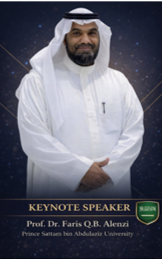
Faris Q.B. Alenzi
Professor of Prince Sattam bin Abdulaziz University
He is a Professor of Immunology at Prince Sattam bin Abdulaziz University, Saudi Arabia. He received his M.Sc. and Ph.D. in Immunology from Imperial College London. His research interests include cancer biology, allergy, apoptosis, stem cells, and clinical immunology. He has contributed extensively to medical and biomedical research, scientific committees, and editorial activities. Prof. Alenzi is also recognized for his community and professional contributions, including founding scientific and charitable initiatives in Saudi Arabia.
Workshop About
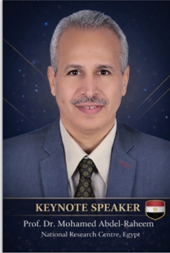
Mohamed Abdel-Raheem
Professor of National Research Center, Egypt
He is a Professor of Entomology and Biological Control at the National Research Centre, Egypt, in the Pests and Plant Protection Department. His research focuses on plant protection, applied entomology, insect ecology, integrated pest management, and biological control. He has extensive academic and research experience, with numerous scientific publications, books, and editorial contributions in agricultural and biological sciences.
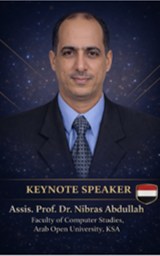
Nibras Abduallah
Associate Professor of Computer Studies Arab Open University, KSAer, IEEE)
Deep generative models (DGMs) have demonstrated significant potential across a wide range of applications in artificial intelligence. As the field continues to evolve, several key directions are emerging as critical to advancing these powerful models. This keynote explores the future of deep generative models, with a particular focus on enhancing interpretability to ensure transparency and trust, developing ethical frameworks to support responsible use in research and education, and integrating generative models with other advanced AI techniques to enable more robust and intelligent systems.